

Research-driven Launch: Positioning Atlas Flex Clusters for Success
Multi-phase study supporting the launch of Flex clusters in MongoDB Atlas. This work shaped the product experience and positioning, contributing to clearer pricing, lower churn, and 30% quarter-over-quarter Atlas growth following launch.
Product MongoDB Atlas
Role Solo UXR leading multiple-phased research for a new product launch
Stakeholders Design, Product, Product Marketing, Data Analytics, Senior Director of Product, VP of Growth Marketing
Key Impact 30% accelerated QoQ Atlas growth
Context & Background
MongoDB Atlas is MongoDB’s flagship cloud database product, serving enterprise teams who build and manage data-intensive applications at scale.
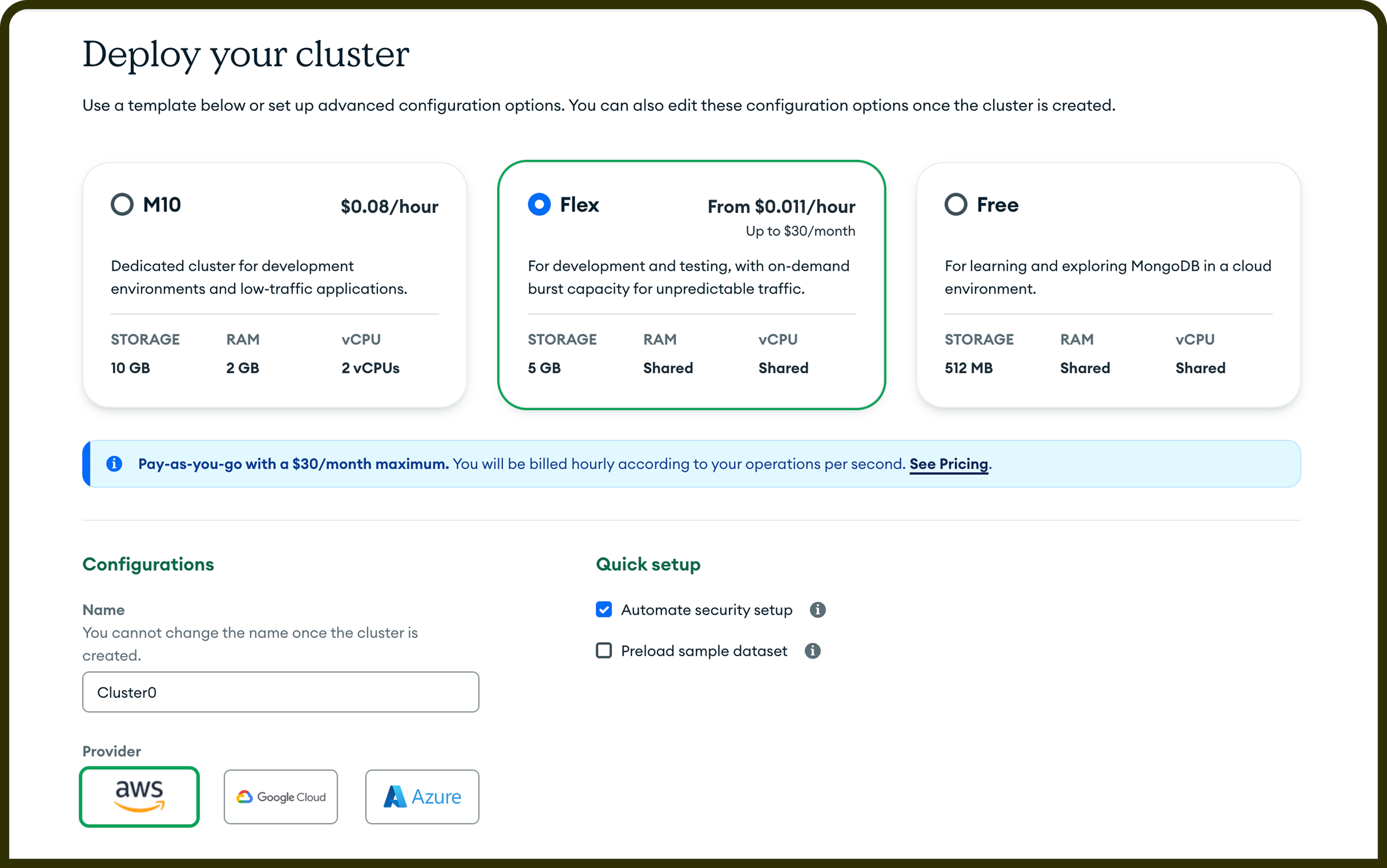
While Atlas had historically offered three cluster tiers (Shared, Serverless, and Dedicated), low Serverless adoption revealed a gap: the vast majority of Serverless instances fell within Shared tier limits, and Serverless bills could be very unpredictable. To address this, the Shared and Serverless tiers were merged into a new cluster offering ultimately named Flex, designed to give customers more elasticity, scalability, and pricing predictability.
With open questions around user impact, pricing perception, and value communication, I conducted research to inform the naming, pricing, and positioning of the new cluster ahead of its February 2025 launch.
The Key Question
How might we clearly communicate the value of this new cluster, so that a major product change drives adoption rather than confusion?
Research Goals
Assess comprehension of the pricing structure and evaluate the interactive calculator
Capture feedback and identify design changes needed
Evaluate naming sets and identify which name options best convey the value proposition of the new cluster
Deliver guidance to rename the new cluster
Gather actionable insights to refine positioning of new cluster ahead of launch
Key Metrics
Click-through-rate (CTR)
Cluster creation rates
Retention rates
QoQ Atlas growth
Contributions & Collaboration
To shape the new product launch, I led a multi-phase research program spanning naming, pricing, and positioning.
Throughout this project I worked closely with cross-functional stakeholders, including:
2 Product Designers
2 Product Managers
1 Product Marketing Manager
1 Data Analytics
1 Senior Director of Growth Product
1 Director of Product Management
1 VP of Growth Marketing
As the sole UX researcher on this project, I had full ownership over:
Scoping research and defining study questions
Crafting multi-phase research plan
Leading research kick-off calls and workshops
Designing all study materials
Recruiting participants
Facilitating all user sessions
Synthesizing and analyzing data
Creating research reports and socializing findings
Methodology
This project called for three rounds of concept testing conducted in quick succession, each building on the last.
During the first round, we evaluated an early iteration of the UI and captured the language that users naturally associated with the new cluster. During the second round, we rapidly evaluated multiple naming sets to narrow down to the two strongest options. The third round compared the two finalist naming sets to reach a decision.
Stakeholder alignment work preceded all three rounds, as the cross-functional scope of this project made it essential to establish a shared direction before any user research began.
Stakeholder Workshops
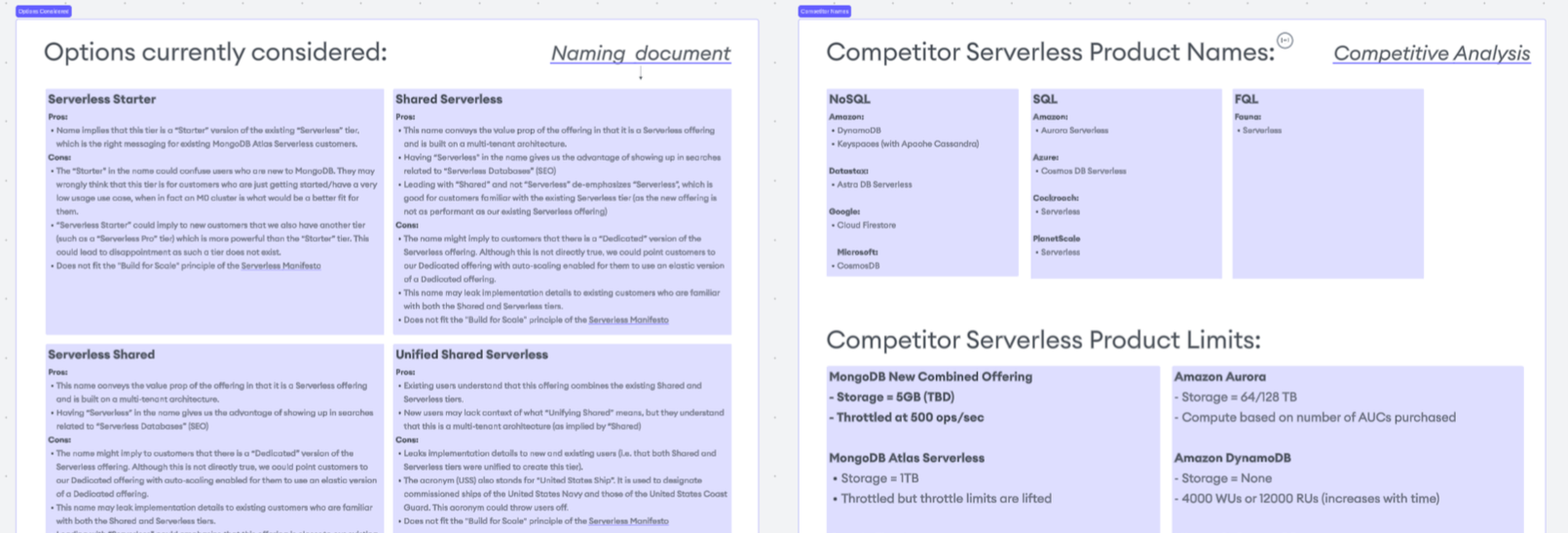
Before any user-facing research began, I co-led a workshop with stakeholders to build alignment on the research plan, surface requirements for naming (including non-starters and constraints to keep in mind), and consolidate the many conversations that had been happening across disparate channels.
Because this project touched multiple product teams and affected MongoDB's flagship product, bringing everyone into the same room was a prerequisite for doing the research effectively.

Concept Testing
(Round 1)
8 participants took part in one-on-one moderated sessions to evaluate the initial cluster-building UI and to begin generating directional signal on naming. Moderated sessions were the right format here because the concepts were early and we needed to probe, follow up, and let users talk.
We recruited a mix of existing Atlas users and non-Atlas users with competitor database experience since it was important to understand both how familiar users reacted to a change in something they already used, and how newcomers perceived the new cluster's value proposition from scratch.
This round identified early design changes, surfaced pricing and cluster capacity comprehension issues, and began capturing the language users naturally reached for when describing this cluster type - which in turn, helped Product and Marketing ideate naming alternatives.
Unmoderated Concept Testing (Round 2)
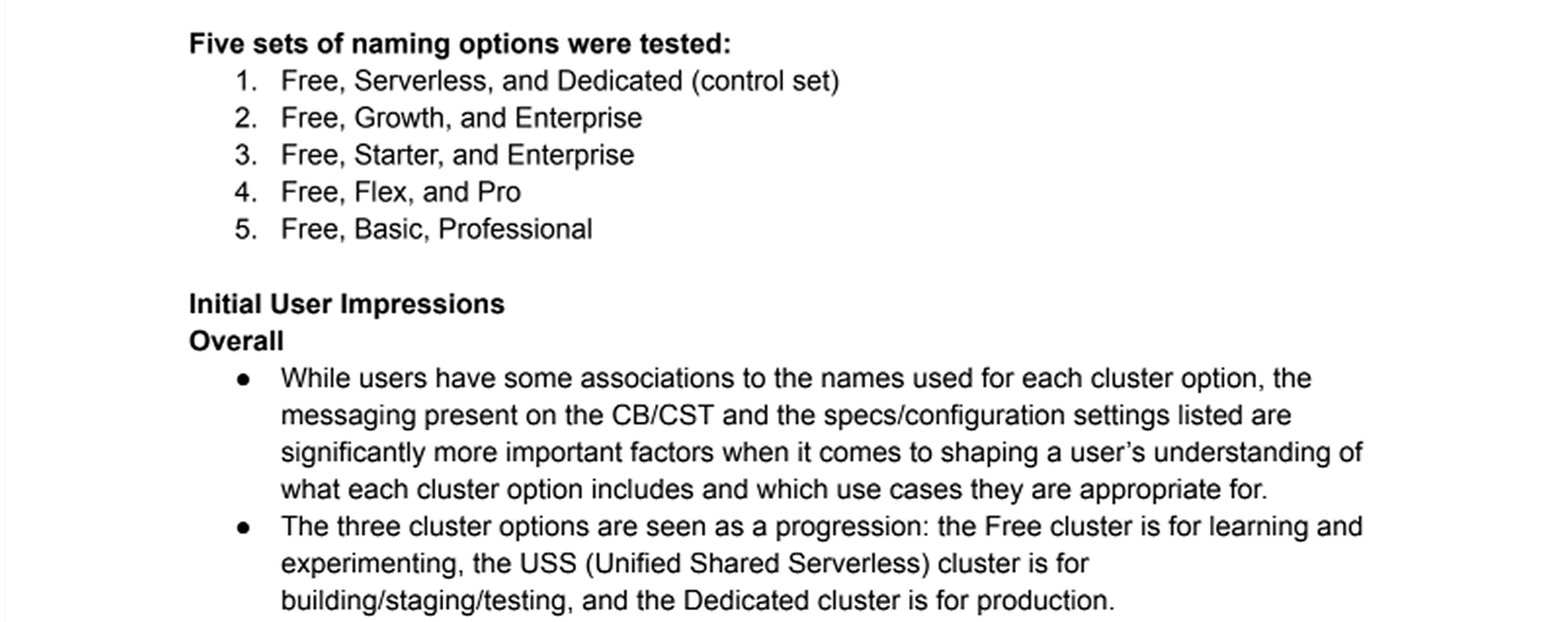
50 participants took part in unmoderated sessions across two segments, Atlas users and non-Atlas users. 5 sets of names were evaluated during this round, with each set being evaluated by 10 participants. The existing cluster names were used as a control set.
During this round, we shifted to unmoderated since we’d established a clear question (which names resonate?), and we needed volume and speed rather than depth.
Running a large unmoderated study on UserTesting.com allowed us to gather directional data across all five naming options rapidly, helping us identify which two naming sets best indicated what each cluster tier offered.
Concept Testing (Round 3) + Painted Door Test
12 participants (Atlas users and non-Atlas users) took part in moderated sessions comparing the two finalist naming sets: Free/Flex/Dedicated and Free/Starter/Pro. Users provided feedback on both naming sets and we alternated which set we showed first in order to reduce the likelihood of order bias. In addition to capturing feedback on the naming sets, we used these sessions to evaluate updated UI designs and pricing comprehension.
These sessions ran in parallel with a Painted Door test conducted by the Analytics team, combining qualitative feedback with quantitative engagement data to reach a well-supported decision.
Flex outperformed Starter on both dimensions (higher stated preference and higher engagement rates), providing the cross-functional team with a clear naming recommendation.
Analysis & Collaboration
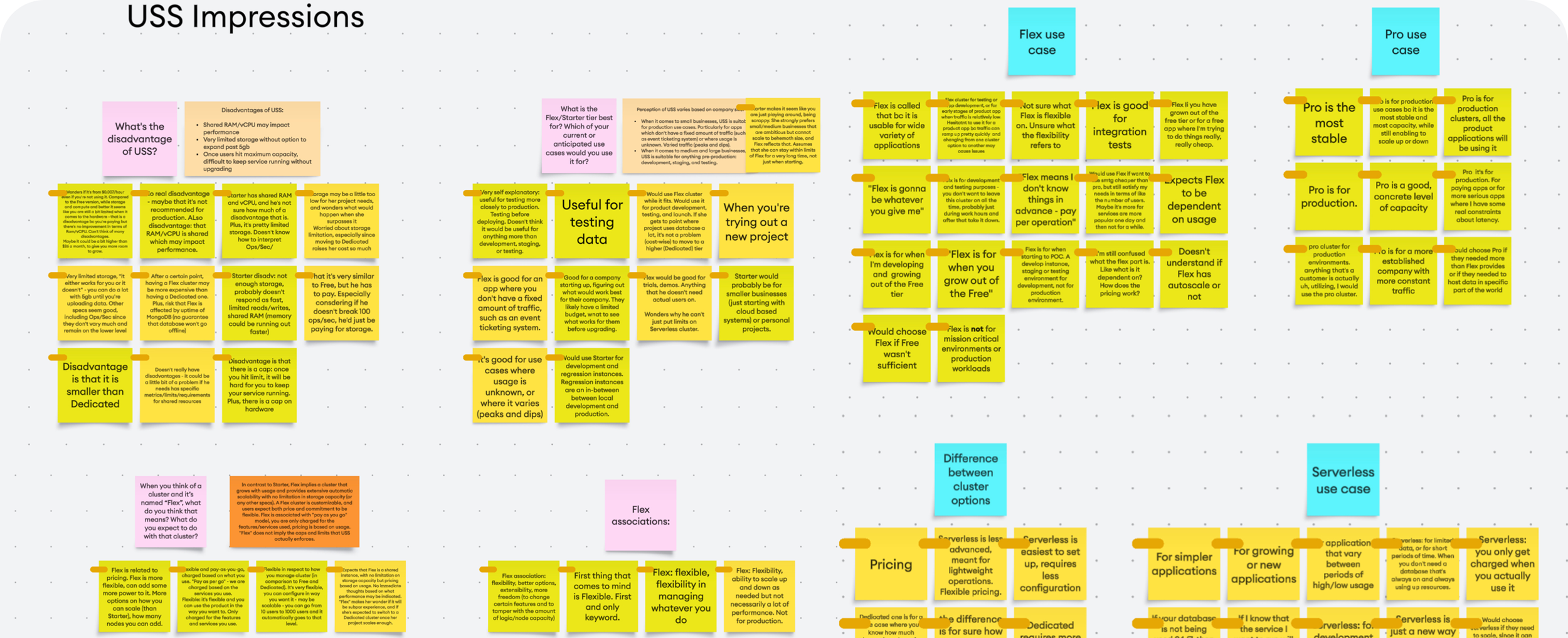
After each round of concept testing, I moved quickly: affinity mapping in Lucidspark and writing research memos to share ongoing findings before the next round of evaluations began.
Socialization
Speed mattered: the core working group was constantly making decisions based on what research was surfacing, so getting findings to them first was the priority.
With so many decisions dependent on each other, collaboration was constant: daily check-ins, Slack threads, and shared Lucidspark boards kept the group aligned between formal meetings.
For higher-stakes conversations (such as the final naming discussion, which involved the Director of Product Management and VP of Growth Marketing), I created readout decks outlining research implications and recommendations. The goal was to give senior stakeholders enough context to make decisions with confidence, without requiring them to have followed every iteration of research along the way.
Insights & Recommendations
Cluster names are perceived as either “technical/ descriptive” or “branding/marketing.”
“Technical/descriptive” names (e.g.,Flex, Dedicated) tell users what to expect from each cluster, while “branding/marketing” names (e.g., Starter, Pro) make it easy to understand hierarchy but do not provide details on what each offering includes.
Recommendation: MongoDB users are a very technical audience - choose a name that aligns with their mental model.
Cluster perception changes based on name.
“Starter” implies a basic cluster with limited features, while “Flex” indicates a flexible, pay-as-you-go cluster with more advanced functionality.
Recommendation: Move forward with the name “Flex”, as it is technical, easy to understand, and descriptive.
The maximum monthly price is perceived as a safety net.
However, users don’t know what happens if the cluster capacity is met or exceeded, and service interruptions are a concern.
Recommendation: Provide an easy, visible upgrade path for clusters getting close to upper capacity limits.
Users struggle to understand hourly cost due to its complexity.
While the new cluster’s “pay as you go” model is straightforward and easy to understand, hourly costs are confusing due to how small they are (sometimes less than one cent).
Recommendation: Provide an estimated monthly cost for users to more easily grasp how their billing may vary.
Results & Impact
Following the launch of Atlas Flex in February 2025, we saw:
30%
accelerated Quarter-over-Quarter Atlas growth
9%
faster conversion to a
paid tier cluster
10%
increase in paid tier retention