

From Frustration to Fluency: Reshaping the MongoDB University Experience
End-to-end UX research supporting the complete redesign of MongoDB University (MongoDB's developer learning and certification platform) contributing to a 145% engagement increase over the legacy platform and 40% YoY growth in content page views.
Product MongoDB University
Role Solo UXR leading end-to-end mixed-methods research for a platform redesign serving 50k+ learners
Stakeholders Design, Product, Curriculum, VP of Education, Learning Ops Manager
Key Impact 145% increase in engagement (vs. legacy platform), 65% increase in lab completion
Context & Background
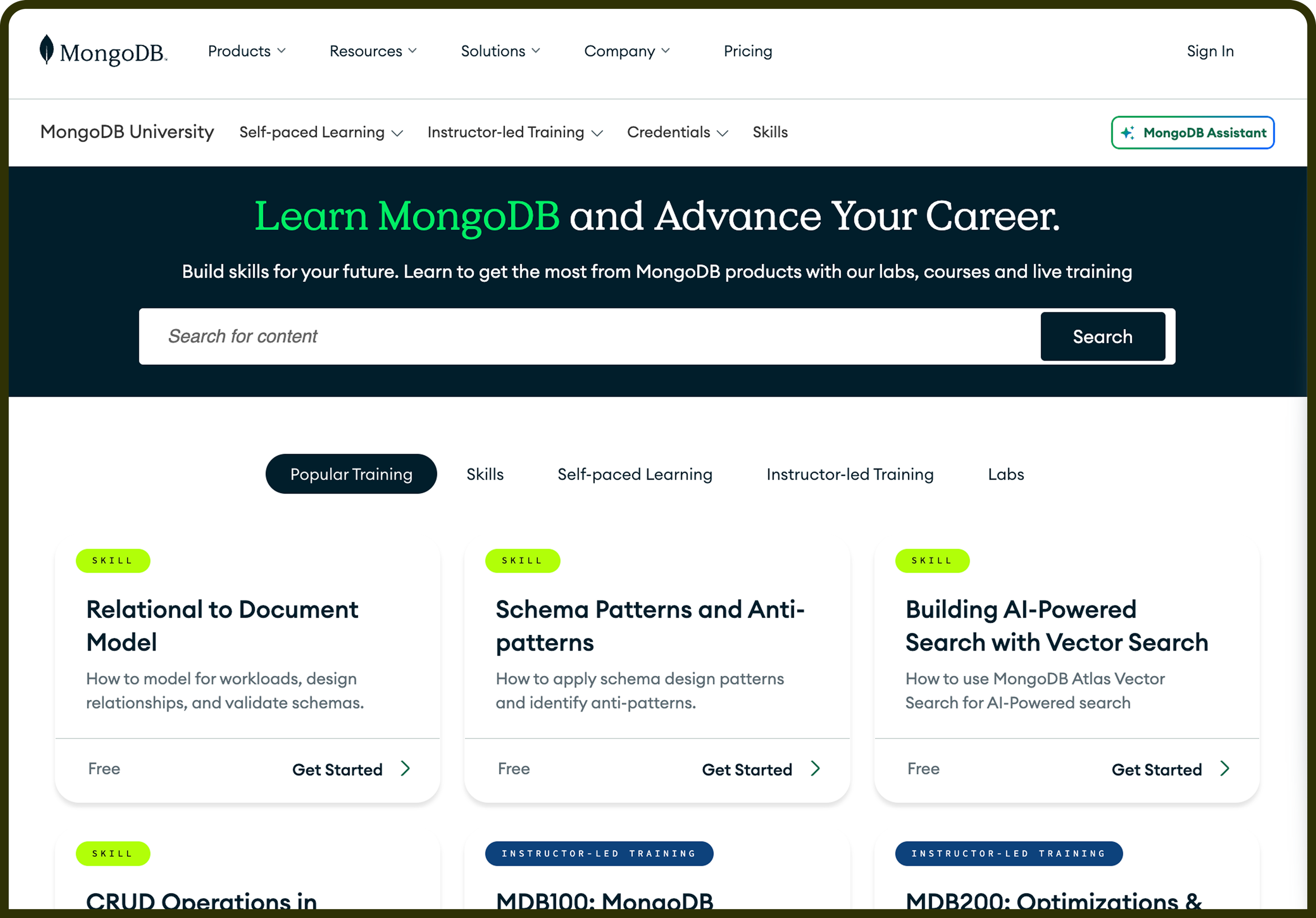
MongoDB University is a learning platform with an extensive catalog of online courses and certifications aimed primarily at developers, DBAs, and students who want to build applications with MongoDB.
While University had been established in 2012, the platform had struggled with low course completion rates, confusing navigation, and high certification exam failure rates.
To address this, University underwent a ground-up redesign of both the platform and the curriculum in 2022. To help the launch go as smoothly as possible, I conducted research to inform key product, design, and curriculum decisions ahead of the redesign.
The Key Question
How might we ensure MongoDB University is easy to use and feature-complete at launch, while building habits that drive long-term learner retention?
Research Goals
Assess and improve the usability of the content and certification platforms
Gather actionable insights to refine and prioritize University MVP features for broader launch readiness
Identify major issues or bugs that need to be immediately addressed
Identify the right incentives to boost engagement and certification rates
Key Metrics
Course completion scores
Lab engagement metrics
Certification pass rates
Task success rate
Contributions & Collaboration
To tackle this research question, I led a multi-phase research program spanning usability, motivational psychology, and curriculum design to shape a platform relaunch.
Throughout this project I worked closely with cross-functional stakeholders, including:
3 Product Designers
2 Product Managers
VP of Education
Learning Ops Manager
Director of Certification
4 Engineers
As the sole UX researcher on this project, I had full ownership over:
Scoping research and defining study questions
Crafting multi-phase research plan
Leading research kick-off calls and workshops
Designing all study materials
Recruiting participants
Facilitating all user sessions
Synthesizing and analyzing data
Creating research report and socializing findings
Methodology
Research methods were sequenced intentionally to move from discovery to evaluation in a way that built on each prior phase.
3. Usability Testing
24 participants took part in moderated and unmoderated usability testing sessions conducted across multiple design iterations.
This phase came last, once the concepts had enough fidelity to stress-test, and it focused on identifying MVP feature priorities, refining features, and surfacing high-severity usability issues before launch.
Moderated sessions were used where follow-up questions and real-time probing would add the most value, and unmoderated sessions complemented these by giving us the ability to capture a higher volume of feedback rapidly.
A mix of participants with and without prior University experience were recruited, as it allowed us to evaluate the platform on two distinct dimensions simultaneously: how first-time users discover and onboard to content, and how habitual MongoDB learners experience the transition away from the legacy platform they had experience with.
1. User Interviews
15 participants took part in one-on-one virtual interviews, spanning three user segments by age, role, and MongoDB experience.
Interviews came first to ground the work in real user needs before any design decisions were made, providing an understanding of what was broken about the legacy platform.
These sessions also helped us begin shaping our thinking around learning motivation: specifically how to structure content and incentives in ways that would keep users engaged over time. Because the effectiveness of those incentives was likely to vary across age groups and levels of experience, deliberately recruiting across a range of user profiles was important to capture that nuance.
2. Diary Study
7 participants took part in a three-week diary study, each testing a different combination of content units. This phase of research allowed us to evaluate proposed learning solutions in a more naturalistic context: capturing how users actually engage with learning content over time rather than in a single sitting.
The varied content combinations were intentional, as they allowed us to evaluate the modularity of the redesigned curriculum.
All participants had development experience but no prior MongoDB background, which was a deliberate choice to understand how someone brand new to the platform navigates onboarding - a critical use case for a redesigned University experience.
Analysis & Collaboration
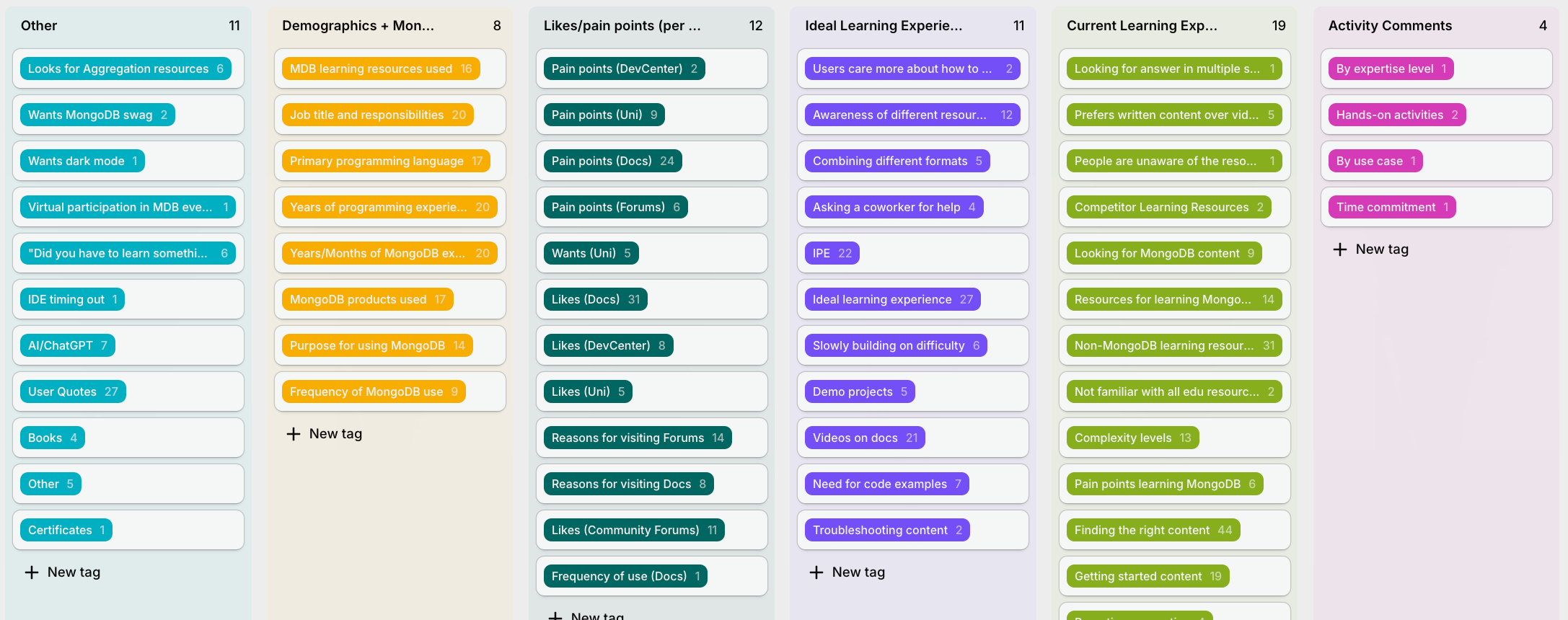
I tackled the qualitative coding of user interviews, diary studies, and usability testing sessions using Dovetail and AirTable.
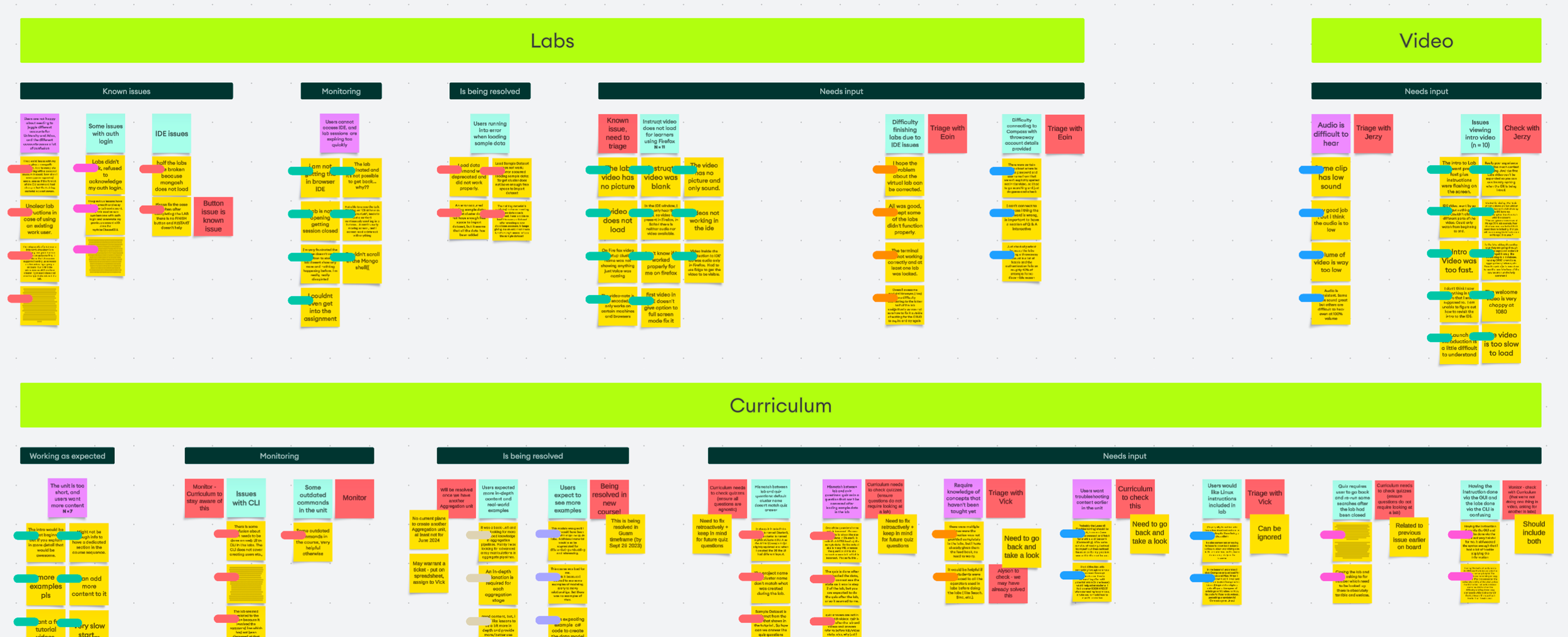
Plus, I pulled out some key findings into Lucidspark for workshops with University domain leads. The goal was for leads to have direct interaction with research findings and user feedback in order to brainstorm and align on next steps.
Socialization
Given the number of teams involved in the redesign, findings were shared continuously rather than saved for a final readout.
Weekly meetings, leadership workshops, newsletters, and All Hands calls kept all stakeholders aligned and gave each team the visibility they needed to act quickly, rather than waiting until the end of a phase to learn what users were telling us.
Insights & Recommendations
The clearest measure of this research's impact: it changed what got built.
Below are a few examples of insights that directly influenced the launched designs and product roadmap.
Users come to MongoDB University with a specific learning goal in mind.
Rather than browsing through available content, they prefer to search for content around a specific topic.
Recommendation: Make the search bar a prominent, consistent element across University - prioritizing visibility on the homepage and content catalog.
Developers are motivated by a challenge: the harder the task, the more engaged they become.
The current quiz format undermines this by being too easy to pass, leading users to disengage rather than take the material seriously.
Recommendation: Raise the difficulty bar in MongoDB University quizzes by removing access to correct answers and explanations until a quiz is passed.
Users lose momentum when units end abruptly, with no clear path forward.
Interest in a topic doesn't automatically translate to knowing where to continue learning.
Recommendation: Guide users to the next unit or course upon completion, and surface related content across MongoDB Docs and DevCenter to support deeper exploration.
Certification vouchers and discounts are meaningful motivators.
Certification signals credibility to employers, making MongoDB a preferred platform when users are weighing their learning options.
Recommendation: Offer certification discounts to users who complete a learning module, incentivizing both enrollment and follow-through on a learning path.
Results & Impact
Compared to the legacy University platform, the redesigned experience delivered:
145%
increase in engagement
with University content
40%
Year-over-Year increase
in content page views
65%
increase in lab session
times and completion
174%
increase in certification
rates